Consumer Behavior
How self-service operators win by automating through curation
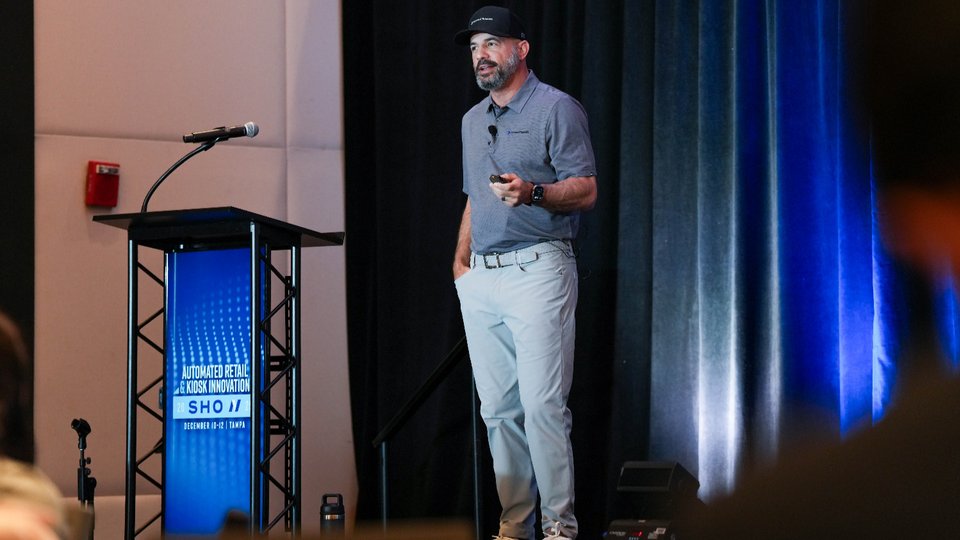
Josh Rosenberg, founder of Forward Thinkers, outlines challenges the self-service and automation industry and what operators need to do to overcome those challenges during a keynote at the 2025 Automated Retail & Kiosk Innovation Show.
February 17, 2026 by Judy Mottl — Editor, RetailCustomerExperience.com & DigitalSignageToday.com
 ChatGPT
 Grok
Grok Perplexity
 Claude
Consumers embrace automation — they love the convenience but they want an engaging experience and not just a transaction.
There's big growth ahead for automated retail and self-service with opportunities everywhere from retail space to high-traffic hubs but that opportunity can only be tapped if operators move beyond a location-by-location approach and adopt a broader live, work, play mindset.
Operators must align brand, placement, equipment, messaging and experience to meet modern consumers expectations. Autonomous opportunities exist in channels like airports (walk-in/walk-out), healthcare (addressing limited cafeteria hours and distant access), and university campuses (safety and experience for students).
"If we can think like a consumer we can meet the customer where they are because we're all consumers ourselves. Today's journey is understanding consumers are in control and we have to meet them at that point," said Josh Rosenberg, founder of Forward Thinkers, a firm specializing in executive coaching, strategic planning and business transformation. With over 30 years of experience, including 18 years at The Coca-Cola Company, he focuses on scaling high-performance organizations through data-driven insights and leadership development.
Rosenberg shared the above insight during his keynote talk at the Automated Retail & Kiosk Innovation Show (formerly the Self-Service Innovation Summit), held in Dec. 2025. The annual event, which will take place Dec. 14-16 this year in Miami Beach, Florida, showcases the latest technologies and trends in self-service retail, vending, interactive kiosks and more.
The keynote address, "The Experience Shift: How Self-Service Can Win by Curating, Not Just Automating," began with Rosenberg asking attendees to pull out their phones for what would be an interactive session, highlighting consumer behavior among the attendees as Rosenberg outlined challenges the self-service and automation industry faces and what operators need to do to overcome those challenges.
https://automatedretailandkiosks.com/pre-register/
It's all about the consumer
Success in retail automation and self-service is all about meeting and exceeding consumer demands.
"We need to put our consumer hat on and that's how we should be thinking about to drive our business. Consumer demand is there. If we can automate – curate the brand experience we can own the consumer," said Rosenberg, who also outlined a blueprint for where the industry is headed.
Owning the consumer will prove valuable given autonomous retail is growing, projected to be a $68–$75 billion industry by 2030.
"If we can think like a consumer we can meet the customer where they are. Today's journey is understanding consumers are in control. Consumers, we want convenience speed and accuracy. Consumers want frictionless engagement. How they pay how they engage and they want consistency. You need to understand the consumer first," he said.
One place to shop
The future of automation is all about giving consumers one place to shop, said Rosenberg, to be "the primary source for consumers." He noted Japan has more self-service than retail storefronts and it's a simple formula.
"It starts with the right product, then right delivery mechanism, then the right message. Controlling the brand is critical as it's key to building loyalty," he said.
Challenges in play
The big challenge in the self-service and automation industries is that the industry has been slow to innovate and slow to curate.
"We've got to innovate quickly and we have to curate quickly," said Rosenberg.
The default consumer behavior after the pandemic has shifted to mobile-first, app-first and self-service first, explained Rosenberg.
"The opportunity for businesses is to respond to this shift with curation through self-service and autonomous retail."
One key success factor will be adopting open API standards as many of the biggest barriers to growth stem from operations being locked into closed system. The scenario, said Rosenberg, creates friction for the consumer and slows innovation.
"To move forward, autonomous retail operating systems need to be open, connected, and interoperable," he said, explain there needs to be a "buy, build or borrow strategy" for optimizing capital and speed to market.
He referred to the vast benefits gained by Levi's and Ulta in adopting unified inventory APIs that allowed the retailers to turn storefronts into micro-warehouses for last-mile fulfillment, increasing revenue by 95%.
Rosenberg added that other companies, including 7-Eleven, are adopting this approach to turn their stores into micro-depots for last-mile delivery.
Key learnings points
In his nearly one-hour talk Rosenberg mapped out an 'experience blueprint,' noting it follows in close step to Coca-Cola's R5 formula.
- Right product.
- Right delivery mechanism.
- Right place.
- Right audience.
- Right moment.
- Right message/ branding.
- Innovation at a fast speed.
In his talk Rosenberg said the speed of innovation is accelerating. "E-commerce took 20 years, mobile/app took 10 years, AI took five years, and the next shift is expected to take less than two years," he said.
He mapped out key success goals for attendees:
- Experience is everything. Consumers want "my drink, my ride, my experience, my way." Starbucks is presented as a winner, not on speed or price, but on customization, convenience and loyalty. Starbucks has 40 average menu items but offers 170,000 drinks that are curated.
- Frictionless engagement. Consumers want consistency, to walk in, get what they want, how they want it and walk out. The essential steps for consumers are to see, decide, pay and receive.
- Autonomous retail. It here and now but still has a small footprint. The market is projected to be a $68-75 billion industry by 2030. Operators must get out of their niches (food and beverage, retail, novelty) and bring services together to give the consumer one place to shop. Japan is cited as a country with more autonomous retail solutions per capita than retail storefronts.
Pre-Register for ARKI 2026Be first in line when registration opens and lock in an extra $200 off the Early Bird rate for the next Automated Retail & Kiosk Innovation Show. |
About Judy Mottl

Related Media
Subscribe
Get the latest news and resources from Retail Customer Experience.
Recent Posts