Customer Service
Home Depot solves Pro customers' top headache with real-time delivery tracker
Home Depot's live tracking tool, available via Home Depot’s website and app, solves what had been a big issue for its Pro customers -- the lack of insight on real-time product delivery.
April 27, 2026 by Judy Mottl — Editor: RetailCustomerExperience.com & DigitalSignageToday.com, Connect Media
 ChatGPT
 Grok
Grok Perplexity
 Claude
The Home Depot's customer service motto is simple. It's all about 'how doers get more done.'
The home improvement brand not only promotes that slogan in marketing, it follows it as well when it comes to solving customer issues and challenges.
The latest example is the development and deployment of a real-time delivery tracker for big and bulky materials orders.
The online tool, available via Home Depot's website and app, solves what had been a big issue for its Pro customers — think construction companies — the lack of insight on real-time product delivery.
Not knowing when a delivery will arrive presents a planning nightmare and leads to budget issues when working on complex projects. If an important delivery is late it not only puts work at a standstill but can lead to unnecessary labor costs for the Pro customer — from construction managers and landscaping firms to plumbers, electricians and anyone working in commercial or residential home services.
Home Depot operates 2,359 retail stores and over 1,250 SRS Distribution locations across all 50 states, the District of Columbia, Puerto Rico, U.S. Virgin Islands, Guam, 10 Canadian provinces and Mexico.
How it works
On a busy job site, time is critical. When a delivery is late that leads to non-productive time. Construction professionals can spend 35% of their time — over 14 hours a week — on non-productive activities, according to an industry analysis by Autodesk. Such a scenario eats into the construction margin and budget.
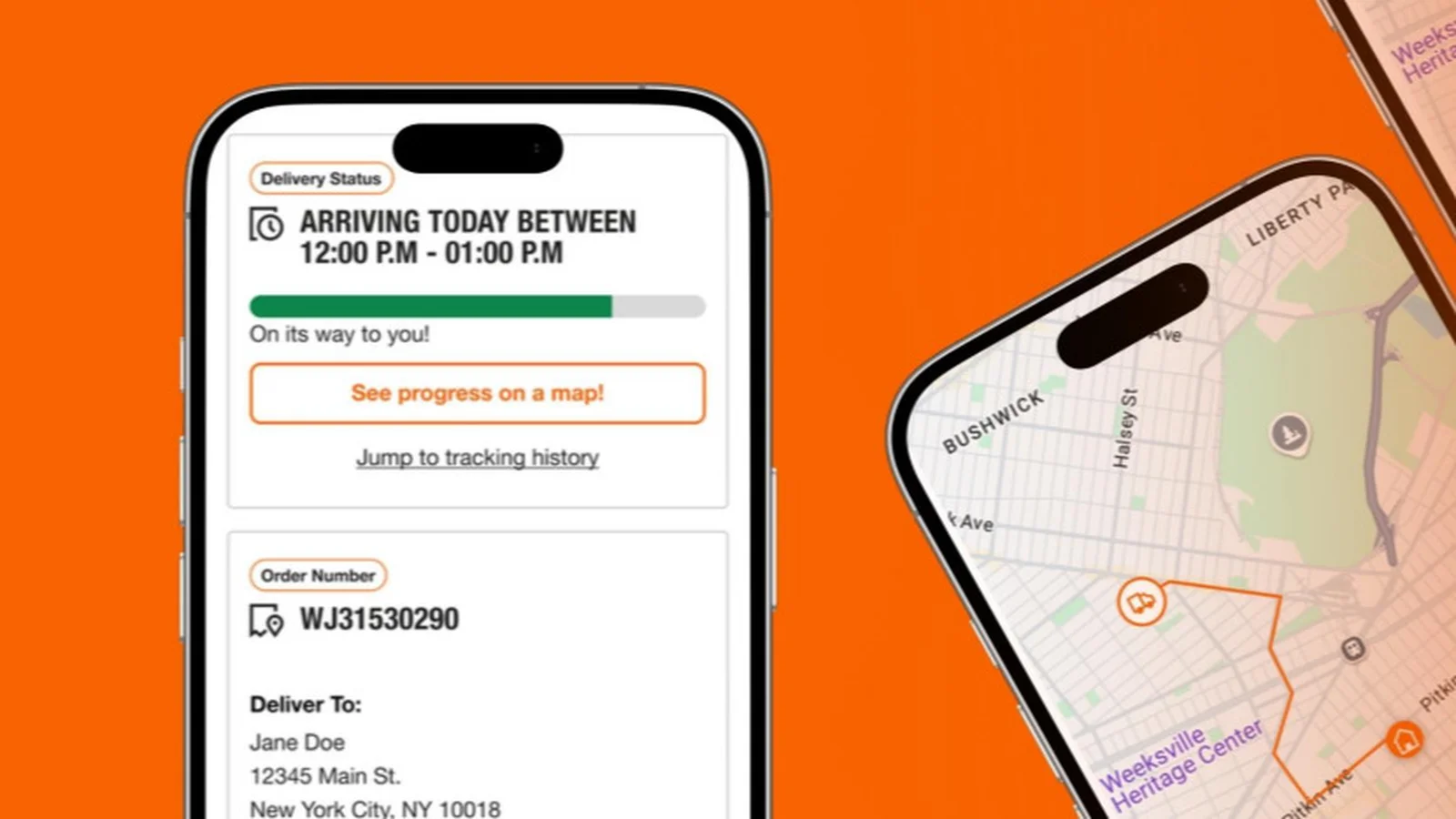
The live tracker provide minute-by-minute updates on deliveries, including visibility into the truck route and remaining stops. Customers can see when their large items will arrive and plan with greater precision, instead of losing valuable work time due to unpredictable delivery windows.
This level of live tracking is powered by the Home Depot driver Handheld application, which transmits real-time GPS data directly from the delivery truck to pinpoint the truck's location and progress on a live map.
An SMS notification is sent, alerting customers the order is on the way. Through the experience, users can:
- Track their delivery driver's live location on a map.
- See the number of stops remaining.
- View the items included in their order.
- Plan their day using enroute turn-by-turn updates.
A final screen confirms the time of arrival, ensuring customers are prepared when their order arrives.
How it came about
"The strategy to provide a delivery tracker for big and bulky items was driven by feedback from Pro customers and an industry-identified inefficiency. We kept hearing the same story: for a professional on a job site, waiting around for a delivery is a huge waste of time and money," Dee Walk, senior vice president, enterprise delivery experience, at Home Depot said in an email interview.
Walk joined Home Depot in 2011 and has held roles of increasing responsibility in supply chain and operations and was most recently the vice president of operations fulfillment, overseeing process engineering, order fulfillment and freight management.
"If you have a whole crew ready to work but the drywall or lumber hasn't shown up, you're paying people to stand around. We saw that this was a massive headache across the industry and realized we had an opportunity to solve it. This tool was created to give our Pros the one thing they can't afford to waste: time. We wanted to give them the peace of mind to plan their day with precision and avoid those costly standstills."
Magic behind the curtain
The tracker is powered by the Home Depot Driver Handheld application, which transmits real-time GPS data directly from the delivery truck. This technology pinpoints the truck's location on a live map, offering customers a transparent, up-to-the-minute view of their order's progress toward its final destination.
Walk calls the Home Depot Driver Handheld app as the magic behind the curtain.
"The 'driver' in the name is exactly that; the delivery driver. The app is basically the digital co-pilot for our drivers for the day, running on a handheld device. It shows them their route, tells them what's next, and lets them update the delivery status in real-time. This is where it gets cool for you, the customer," said Walk, whose teams are responsible for ensuring accurate, damage-free and on-time delivery of orders.
"The driver's app constantly sends out its GPS location which powers the live map you see on your phone. When you see that truck icon getting closer to you, it's a direct link to the driver out on the road. It's the same kind of technology you'd use to track a pizza, but we've built it to handle everything up to a flatbed full of materials, turning that old mystery of 'where's my order?' into a predictable, stress-free experience."
Home Depot has a similar map-based live tracker for large appliance orders that lets customers see the delivery truck's progress. For smaller items the retailer uses the traditional tracking approaches.
"Those items ship with carriers like FedEx or UPS, and you'll get a tracking number in your email to follow the package's journey. The live map is really designed to solve the unique challenges that come with those huge, time-sensitive deliveries," said Walk.
Built in house
The delivery tracker app for Pros was built in-house by Home Depot and it was not an overnight project.
"Our technology team engineered the whole thing from the ground up. Doing it ourselves gave us complete control to build exactly what our customers needed and to tackle the unique challenges of delivering oversized goods, instead of trying to adapt a one-size-fits-all solution," said Walk.
The technology involved years of working to build the best interconnected experience.
"The biggest challenge, by far, was solving that 'last-mile blind spot,'" said Walk.
"For years, once a truck full of lumber left, it was basically off the grid. Building a system to fix that was a huge undertaking, especially because we did it ourselves. This isn't like tracking a small package; it had to be bulletproof for our Pro customers, because for them, a delay can shut down an entire job site. The real challenge was creating a reliable, scalable system from scratch to finally bring predictability to this critical part of the process."
Assessing success
Home Depot has been evaluating the tracker tool since its launch earlier this year and Walk said the ultimate measure of success is the customer's experience.
"We're looking at it in a few ways," he said. "First, are our customers happier? We watch our satisfaction scores very closely, because the goal here is to reduce the stress of waiting for a delivery. Second, are people actually using it? We're tracking how many people are opening the map and following their delivery. If we see high engagement, we know we've built something that's genuinely useful."
Tips, advice
Walk shared insight and tips to other retailers looking to provide customers with valuable tech tools. He said the initial starting point must be identifying the customer's biggest headache.
"This project wasn't born in a tech meeting; it came from hearing our Pros talk about how much money they were losing just waiting around. So, listen obsessively and solve a real, frustrating problem — don't just build cool tech for the sake of it," he said.
"Also, remember that the app your customer sees is only half the story. The technology your drivers use is even more important. If that system isn't reliable and easy for them to use, the customer's experience falls apart. Finally, think of it as a business solution, not just a feature. When you give customers transparency, they stop calling to ask where their order is, freeing up your team and building incredible trust. That trust is what turns a one-time buyer into a lifelong customer."
About Judy Mottl

Judy Mottl is the editor of RetailCustomerExperience.com and DigitalSignageToday.com at Connect Media. She is an award-winning editor, reporter and blogger who has worked for top media for nearly four decades, including AOL, InformationWeek and Internet News, as well as for leading technology providers including HP. She’s written everything from breaking news to in-depth industry trends and reported on technology long before the internet arrived, including the debut of the first smartphone. When she's not sharing insights on digital signage deployments and trends in retail customer experience she's on the beach or watching the latest live murder trial.
Related Media
Subscribe
Get the latest news and resources from Retail Customer Experience.